

5 eBay Fee Mistakes Costing Your UK Shop Profit
With currency conversion fees rising to 2.75% from December 1, 2026, and the per-order charge on items over £10 already at £0.40 since February 2026, many UK retailers are inadvertently pricing themselves out of profit on eBay. The key to profitable sales isn't just selling more; it's understanding and accurately calculating your true take-home after all fees, regulatory charges, and VAT. This guide busts common myths and offers actionable fixes to ensure your eBay listings are always priced for profit.
1. The Myth of the Flat Percentage Fee
Many sellers mistakenly believe eBay's fees are a simple, flat percentage. While business sellers typically pay between 10-13% before VAT per sale, as DashVue highlighted 65 days ago, this isn't the whole story. The reality is a multi-layered structure that can quickly erode margins if not fully understood.
The Fix: Deconstruct the Four-Fee Stack
To accurately calculate your profit, you must account for four distinct charges:
- Final Value Fee (FVF) by Category: This is the percentage of the sale price, varying significantly from 6.9% to 14.9% depending on the product category. For instance, toys & games might have a different rate than health & beauty items.
- Per-Order Fee: A fixed charge of £0.40 for items over £10, or £0.30 for items under £10. This small amount adds up, especially on lower-priced goods.
- Regulatory Operating Fee: A flat 0.35% of the total sale price, including postage.
- VAT on Fees: eBay charges 20% VAT on all its fees. This is often overlooked but significantly impacts your overall cost.
Without factoring in each of these, your perceived profit will be higher than your actual take-home. Remember, new category rates and shop level changes came into effect in September 2026, according to 3Dsellers.

2. Ignoring the Power of a Dedicated eBay Fee Calculator UK
Relying on mental maths or a basic percentage deduction is a common oversight that leads to underpricing. A dedicated UK eBay & Amazon Fee Calculator is an indispensable tool for every serious seller.
The Fix: Use a Calculator for Every Listing
Before listing any product, especially diverse lines like home & garden or DIY, run the numbers through a reliable eBay profit calculator. This tool allows you to input:
- Your item's selling price
- Product category
- Postage cost
- Your purchase cost
The calculator then breaks down all eBay fees (including VAT) and provides your net profit and margin. This is crucial for answering questions like, "If I sell a £50 item as a business seller, what's the actual take-home after VAT, regulatory fees, AND the new 40p per-order charge?" It helps you identify your true break-even point and set a profitable retail price.
3. Not Benchmarking Break-Even by Category & Cost
Most online calculators provide interactive inputs but don't offer strategic thresholds or a "minimum listing value" rule-of-thumb. This means many retailers list low-value items in high-fee categories, unknowingly losing money on every sale.
The Fix: Develop a Minimum Listing Value Matrix
Create a simple matrix or mental checklist for different product costs and categories. For example:
- High FVF Categories (e.g., Electronics, Jewellery): If your item cost is £2 and the FVF is 12.9%, a £4.99 sale might leave you with pennies or even a loss after all fixed fees. Consider a minimum selling price of £7-£10 for these categories.
- Low FVF Categories (e.g., Books, Music): With a 6.9% FVF, you have more flexibility, but the £0.40 per-order fee still demands attention. Even pound lines need careful calculation if sold individually.
A good rule of thumb from an experienced wholesaler: buying the cheapest version of a line usually costs more. Returns and dead stock wipe out any initial saving. This applies to your selling strategy too – if the fees make a cheap item unprofitable, it's dead stock.
4. Misunderstanding Seller Tier Advantages
Many independent sellers operate as business sellers but don't fully leverage eBay Shop subscriptions, often assuming the costs outweigh the benefits. They miss out on FVF discounts that can make a significant difference.
The Fix: Evaluate Shop Levels with a Decision Matrix
Don't just look at the monthly subscription cost. Instead, calculate the total FVF savings you'd gain from a Basic or Featured Shop based on your typical sales volume and average item price. For example:
- A Basic Shop offers lower Final Value Fees in many categories. If you sell 100 items a month at an average £15, even a 1-2% FVF reduction across categories like pet products or auto accessories could easily offset the subscription fee.
- Top-Rated Seller discounts also stack, providing further FVF reductions. Do these discounts actually stack with everything? Yes, they generally apply to the final value fee portion.
Run these scenarios through your fee calculator. You might find that the cost of a shop subscription pays for itself through fee reductions, ultimately increasing your net profit per sale.
5. Neglecting the Impact of Postage Costs on Fees
A common mistake is forgetting that eBay's Final Value Fee and Regulatory Operating Fee are calculated on the total sale price, including postage. High postage costs, even if passed directly to the buyer, still inflate your eBay fees.
The Fix: Optimise Postage & Consider Bundling
Review your shipping strategy:
- Source Cost-Effective Couriers: Regularly compare rates to ensure you're getting the best deal.
- Offer Free Postage When Viable: While you absorb the cost, the perceived value to the customer can increase sales, and you can bake the postage cost into the item price, making the FVF on postage less obvious to you.
- Bundle Items: For smaller, lower-margin goods like stationery or clearance items, bundling them can reduce the impact of the per-order fee. Selling three pound lines together for £5.99 incurs one £0.40 per-order fee, rather than three separate £0.30 fees.
Remember, seasonal stock like seasonal items often sells better with clear, competitive postage, especially if ordered a month before the season truly hits.
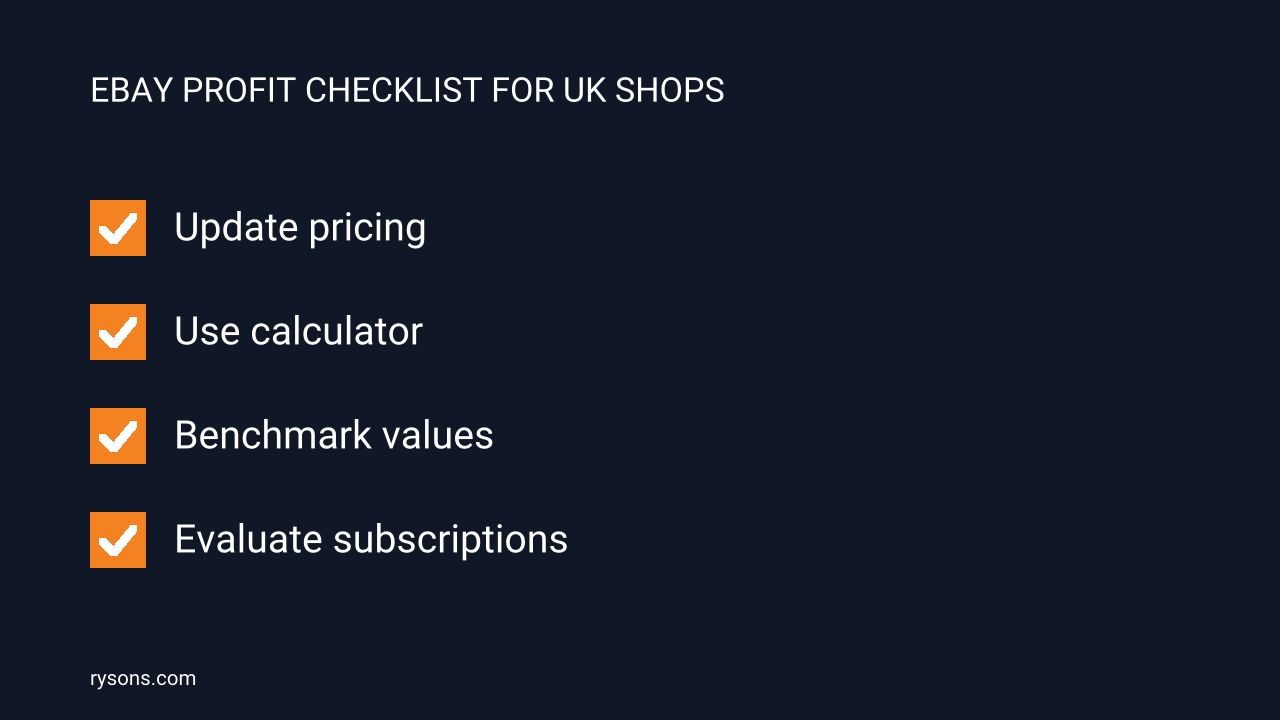
Your eBay Profit Checklist
- Update your pricing strategy: Factor in the new 2.75% currency conversion fee and the £0.40 per-order charge.
- Utilise an eBay fee calculator: Use it for every new product line or price change to find your true profit.
- Benchmark minimum listing values: Know the lowest profitable selling price for each product category based on its cost.
- Evaluate eBay Shop subscriptions: Calculate if the FVF savings outweigh the monthly fee for your sales volume.
- Optimise postage costs: Review courier rates and consider bundling to reduce fee impact on total sale price.
Frequently Asked Questions
How do I account for VAT on eBay fees?
eBay charges 20% VAT on all its fees (Final Value Fee, per-order fee, regulatory fee). When using a fee calculator, ensure it explicitly shows the VAT amount, or manually add 20% to the total of your eBay fees to get the true cost.
Which eBay category has the lowest fee rate for business sellers?
Category rates vary, but generally, categories like Books, Music, DVDs & Films, and Video Games often have lower Final Value Fees (around 6.9%). Always check eBay's latest fee schedule or use an updated calculator for specific rates, as these can change.
Does my Top Rated Seller discount stack with other fee reductions?
Yes, Top-Rated Seller discounts typically apply to the Final Value Fee portion of your sale and will stack with any FVF reductions you receive from having an eBay Shop subscription. This combination can significantly reduce your overall fee percentage.
Ensuring profitability on eBay means being meticulous with your fee calculations. By understanding the true cost of selling and using the right tools, you can confidently price your products and grow your business. For a wide range of stock that offers strong margins, explore the full catalogue at Rysons.com.